Every September, while stands take shape and the carpet — blue everywhere (though in Cannes you can also find it light blue, fuchsia, yellow, orange, red…) — is rolled out, boating companies get caught in the same spiral: rush, show up, look good.
But at the end of the show — in every sense — what really remains?
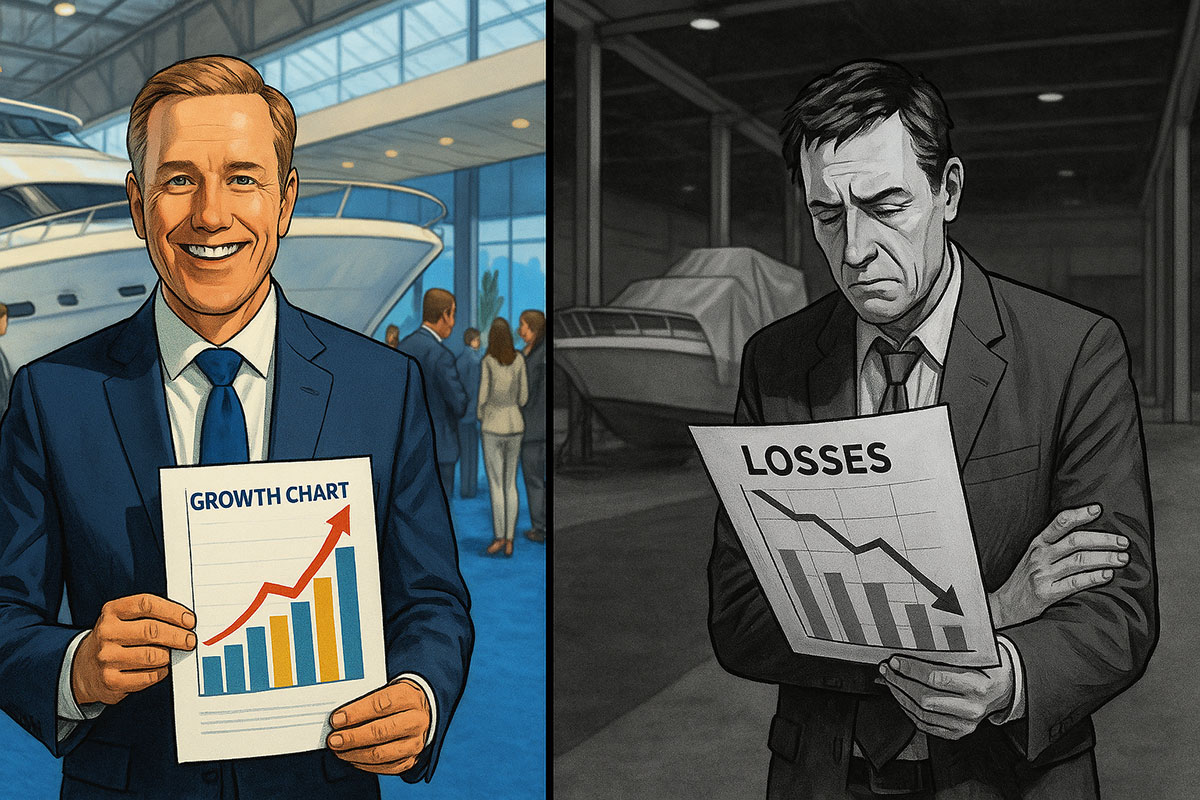
The question is simple and uncomfortable: Boat show, how much do you really cost me?
And if we want to be more analytical and focused on business efficiency, the question becomes: what is the ROI of boat shows?
For those who don’t juggle acronyms every day, ROI stands for Return On Investment: the economic return (direct or indirect) compared to the resources invested.
Translated in plain terms: was it worth spending so much time and money to be at the show?
1. The invisible cost of being there
Attending a show isn’t just renting the space and setting up a stand. There are trips, transfers, staff hours, extra graphics, client dinners, time taken away from other activities… an enormous investment often treated as unavoidable. All of this must be budgeted.
Marketing tip: estimate all costs, including the “hidden” ones. Only then can you begin to reason about the true ROI of boat shows.
2. Vanity metrics vs reality
“We had so many people at the stand.” “Our Instagram post got 200 likes.” Fine, but what did it achieve?
A crowd is not in itself a measure of success, and likes don’t pay the bills.
Marketing tip: separate vanity metrics from the data that really matter. Leads generated, negotiations started, qualified contacts: that’s where the ROI of boat shows is measured.
3. Time as an underestimated variable
Every hour a salesperson spends at the stand is an hour less spent managing existing clients or ongoing negotiations. Every day that production slows to prepare for the show is a day fewer for deliveries. It’s not wasted time, but it is invested time that must be included in the ROI of boat shows calculation.
Marketing tip: include opportunity cost. Every hour spent at the show is one less for active clients or closing deals. Production delays weigh in too.
4. Beyond the “beautiful backdrop”: the value of follow-up
The real value of the show isn’t in the carpet, the stand graphics or the cocktails offered, but in what happens afterwards. A well-written email sent at the right moment, a timely call, dedicated content — all can turn a casual contact into a client.
Marketing tip: measure the aftermath. Not just presence, but especially the effectiveness of the follow-up. That’s where the ROI of boat shows takes shape, and it becomes visible in the months following the event.
5. The paradox of obligatory presence
“If we’re not there, we’ll look small. (or worse: dead).” It’s the fear that drives many companies to always show up. But the right question isn’t “are we present?” — it’s “what do we gain from being present?”.
Marketing tip: better to attend fewer shows, but with clear, measurable goals. A negative ROI can teach more than a silent presence.
Conclusion: return is not an opinion
Participating in boat shows is not an act of faith. It’s an investment, and it must be treated as such.
The ROI of boat shows isn’t calculated just with a calculator, but with a method: total costs, clear goals, measurable KPIs and the ability to turn contacts into business.
Want to know if your investment in boat shows is really delivering results or if you’re just paying for (colorful) carpet? Write to us: at LLiquida we help you turn fairs and events into tangible returns, not just expenses.