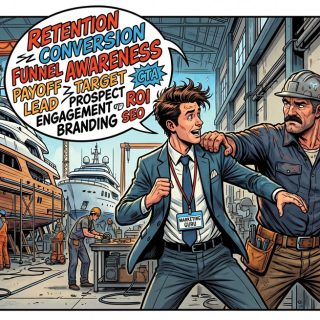
Unless you are a surgeon, buying a scalpel will not make you capable of performing surgery.
So why do you think that having a keyboard is enough to be able to handle marketing and communication?
Probably because if you press the keys, words come together much more easily than anyone would think it is simple to keep someone alive after cutting their stomach open.
And if the spelling is wrong, a little red squiggly line appears underneath to tell you it is not right.
Unlike the patient, who is generally unable to provide feedback regarding the correctness of the operation they are undergoing.
In fact, from a criminal law standpoint, the consequences of bad communication are less severe than those of a surgical procedure performed by someone who is incompetent.
From a commercial standpoint, however, they can have the exact same gravity: killing the subject we want to cure.
A story from a few days ago.
I received a request for an article to be written for a trade magazine about a shipyard that wants a company profile presentation.
The interview with the head of sales was a succession of “I don’t know”, “I’m no expert”.
It was like talking about football to write for a major sports magazine with someone who has seen a ball once and knows that more or less you only use your feet, but sometimes you don’t.
Finally, they know that offside, the manager, and man-marking exist, and that they are good things.
So, to get some useful information, I retrieved the info from the company website and from a few articles previously published in newspapers.
And I prepared the piece, which had the task of making this shipyard interesting and alternative to the countless shipyards that already exist and sell.
Since it is a job commissioned by a paying client, I sent the manuscript to the company in question for review, saying: “check that all the technical info is correct”.
I received a reply email in which the hook of the piece was completely changed.
Mind you, there was nothing technical, but only the accompaniment of the reader toward the core of the story: why you should buy a boat from this company.
Note from the sender (verbatim, and as they used to say in American TV shows: the names have been changed to protect the innocent):
«In this first paragraph, I would start by picking up the introduction we have on our website regarding our shipyard.
A thought that has accompanied John Doe from the very beginning, since he first imagined the Beautiful Boats shipyard: to create vessels capable of combining performance, elegance, and innovation without compromise, where every technical choice stems from a precise vision and every detail has a reason to exist.»
WOW, I am moved…
Aside from being the hundredth time I have read these words tied to a shipyard, think about how useful they can be to differentiate it from the rest of the market.
And second: it is obvious that they do not understand one of the basics of communication.
If I, the reader, see an article in a magazine that publishes text that precisely mimics what is written on the company website, what I think is: this is a plug, and a poorly written one at that.
That an entrepreneur steps in to state the direction their company must take is fundamental.
But why confuse what pleases the “boss” with what convinces the market?
Why do you ask for communication and then expect to base it on corporate slogans?
Let me flip the question on you: would you want to sail on a boat designed and built by someone who deals with marketing and communication for a living?
Then why do you entrust your communication to someone who designs and builds boats for a living?
Ah, outsourcing the work only to then pretend to tell them how to do it falls under the exact same case.