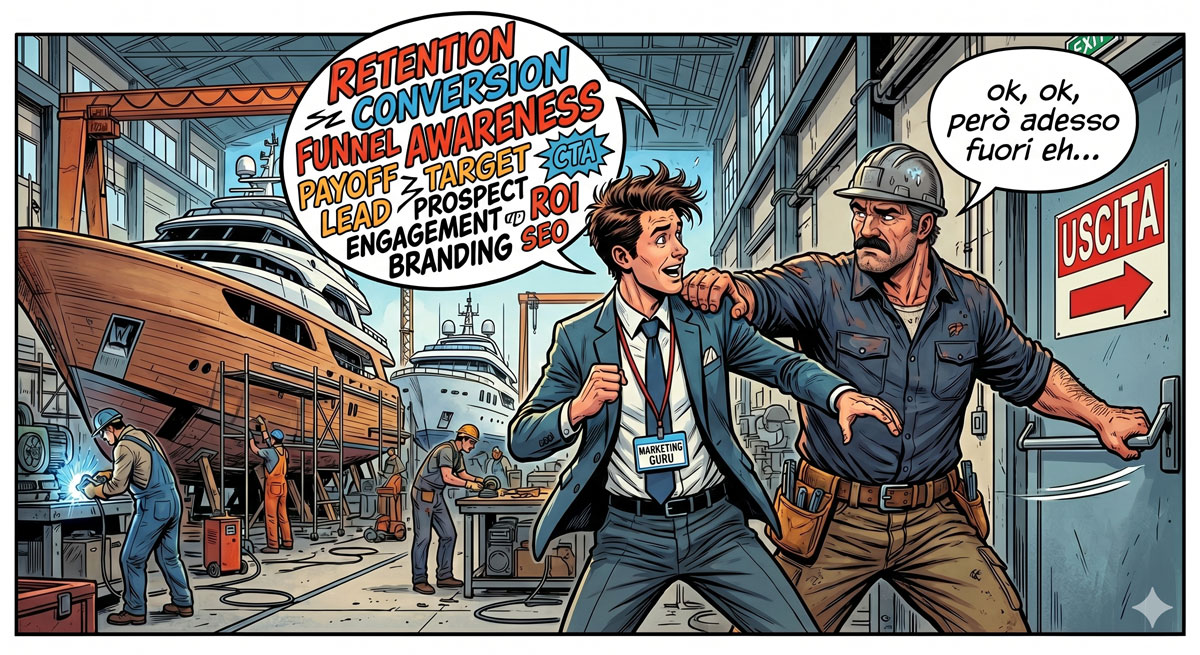
It often uses English words for simple concepts.
Useful, fundamental things, but spoken more as if they were gibberish rather than real concepts.
And then it is surprised when the average shipyard owner looks at the consultant with the same trust they reserve for weather forecasts based on the analysis of bird entrails.
Let’s try to do it differently.
And in translating what the expert on duty means when using certain words, you also get to see what you need to say when you communicate.
Do you exist? The first goal of any communication activity is visibility: in jargon, awareness.
People need to know you exist.
Not understand what you do, not want to buy: just know you are there.
It is the lowest step, but without that one, you cannot climb.
The goal is simply to register your presence in people’s minds before explaining what you do or proposing a purchase.
A shipyard that does not exhibit at boat shows, does not publish anything online, and lacks a recognizable digital presence has a problem of perceived existence.
Then of course there is the case where someone sees a friend’s boat, gets on board, falls in love with it, and buys it.
But it is a case that, although real, is quite sporadic: I would not base my commercial strategy on it.
Are you on the list? When someone starts evaluating a purchase – a boat, a storage service, a charter – they mentally build a list of options.
The interest phase (for the educated: consideration) is the one where they decide whether you are on that list or not.
Existing is not enough.
You need to be relevant at the moment the customer is searching.
Being in front of the potential customer’s eyes as constantly as possible is an infallible system to increase the chance of being on the list.
And this is because, basically, our brain does not like to make an effort.
This is proven by various studies, including those with which psychologist Daniel Kahneman won the Nobel Prize in Economics in 2002, a fine collection of which can be found in the book Thinking, Fast and Slow.
If I have to choose something and one option automatically pops into my head that seems fine, why should I make the effort to think of another?
Have you closed? Here we talk about conversion, but the kind that has nothing to do with religious faith.
Conversion is the moment interest becomes action: a signature, a phone call, a bank transfer. It is the phase that everyone measures (among those who measure their results).
Unfortunately, it is often the only one they measure, and for this reason, it is also the one on which the most energy is wasted.
The paradox: if you did the two previous phases well, conversion is almost, actually let me rewrite it in capital letters: ALMOST a consequence. If you are forcing it, you probably skipped something before.
Watch out for two things.
One, conversion is not necessarily a sale: sometimes the purpose of a campaign is to get a contact request or information.
On the other hand: how many boats have you sold directly at a boat show versus how many contacts you collected?
Two, in the nautical industry, where contracts swing on huge figures and complex negotiations, conversion requires gigantic relational sales and negotiation skills.
Exceptional marketing brings the qualified lead, but it does not sign contracts instead of the salesperson.
The important thing is to be clear about what kind of conversion we intend to have at the end of each activity with this purpose.
Do they come back? Customer loyalty (when you meet the consultant on duty tell them retention so they are happy) is the phase that the nautical sector systematically underestimates.
Yet according to several studies cited by Harvard Business Review and taken up by various marketing analysts, acquiring a new customer can cost at least 5 times more than maintaining an existing one.
Who also performs another service for the shipyard or nautical professional: they cost less to manage, buy more easily, bring others with them.
Loyalty programs in shipyards can be counted on the fingers of one hand.
Post-sale newsletters as well.
Structured follow-up after a charter season, almost non-existent.
It is a huge opportunity. Left there.
And, look at the magic: retention (customers who come back and speak well of the boat) directly feeds awareness (new visibility) through word of mouth, which in the nautical industry is the primary sales channel.
These four phases are the structure of any commercial relationship that works over time.
Then they formatted them as academic theories.
But they are based on how our brain works.
Which, it is good to remember often, resorts to reason only when it has to justify a choice it has already emotionally made.
In fact, channels change, the product changes, the market changes.
But the logic, that does not.