Why do we believe in something?
Basically for two reasons: either because we have seen and experienced it directly, or because we trust who is telling it to us.
In the second case, if what they tell us is – in our opinion – hardly plausible, we need facts, data, and evidence to make the statement credible.
Simple, right?
In theory, we are logical machines weighing millimeters and knots of speed.
In practice, we are much more like worshippers looking for a parish.
The dogma of likability
Let’s set aside for a moment the more cynical aspects of our brain, those we usually don’t even admit to ourselves.
If a source “dislikes” us or, more simply, doesn’t share our general vision of the world, we tend to undervalue it.
If a shipyard we don’t like publishes amazing data, our first thought isn’t “what engineering!”, but “I wonder how they manipulated the tests.”
To paraphrase Jessica Rabbit: we’re not bad, we’re just wired that way.
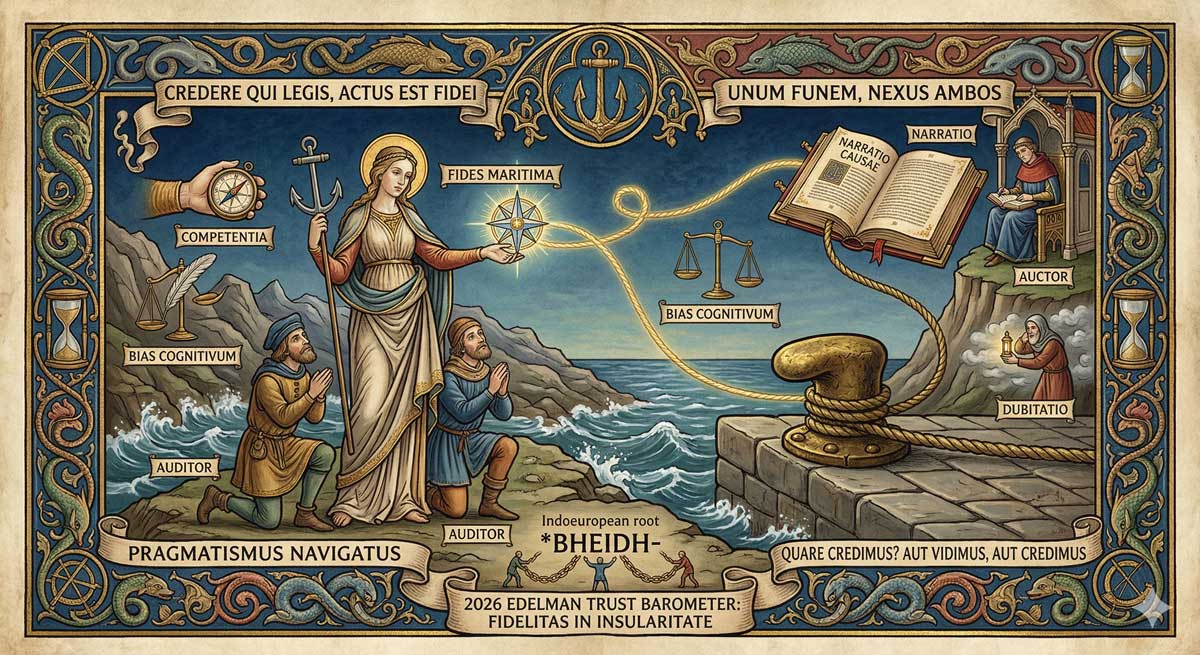
The 2026 Edelman Trust Barometer study confirms this with surgical ruthlessness: 79% of people today are unable to trust information coming from sources outside their own “bubble” of values.
If I don’t feel you are like me, your data is just noise to me.
Or worse, lies.
And that is exactly why two identical boats, told by two different shipyards, are not perceived in the same way.
Understanding is believing (for a moment)
The truth is that reading is an exercise in surrender.
According to the Spinoza reflex (studied by Daniel Gilbert in his experiment Understanding and Belief), our brain is not a notary checking documents before signing.
On the contrary: to understand a sentence, we must first accept it as true.
Something we are generally inclined to do.
Rejecting an idea requires a secondary, conscious mental process.
The results suggest that humans naturally tend toward credulity, especially when they lack the time or cognitive resources to critically analyze the data received.
In practice, doubt is a cognitive luxury that comes later, if we still have the energy left.
Furthermore, a 2018 Rand Corporation report (The Truth Decay) affirms what is already stated by the phrase (never actually said by Goebbels): repeat a lie a hundred, a thousand times and it will become a truth.
Meaning that today, much more than in the past, we tend to confuse opinions with facts and give more and more value to the former over the latter.
These conclusions help explain various cognitive biases, such as the tendency to believe insinuations or the difficulty in correcting deep-seated prejudices.
And often also the proliferation and endurance, especially in our nautical world, of “pirate” shipyards that manage to sell unthinkable boats..
In this sense, every blog post, every brochure, every technical sheet is a roll of the dice.
The writer throws a line; the reader decides whether to catch it and tie it to their cleat.
It is no coincidence that “faith” and “trust” share the same Indo-European etymological root: *bheidh-, which means precisely “to bind.”
When you read what I write, we are trying to tie a knot together.
The role of data: they are anchors, not compasses
If reading is an act of faith, what is data for?
They don’t serve to create faith from nothing – that is born from reputation and esteem – but they serve to sustain it when the sea gets rough and doubt begins to rise.
Data is the evidence our rational side needs to not feel stupid for having given credit to an emotional promise.
Data does not support faith; faith does not need it.
Data justifies a choice already made.
In nautical marketing, seasoned pragmatism is not the opposite of faith: it is its life support.
Because solid competence is indeed born from problem-solving, but it only flourishes when there is someone willing to believe that you actually solved that problem.
Tell the truth, before checking the technical sheet, did you check if you liked the person who signed it (or if you deem them competent)?