I received a newsletter this morning. No photos of sunsets at anchor, no glasses of champagne, and no cream-colored leather. The sender is a company we’ll call “Saddles & Props.”
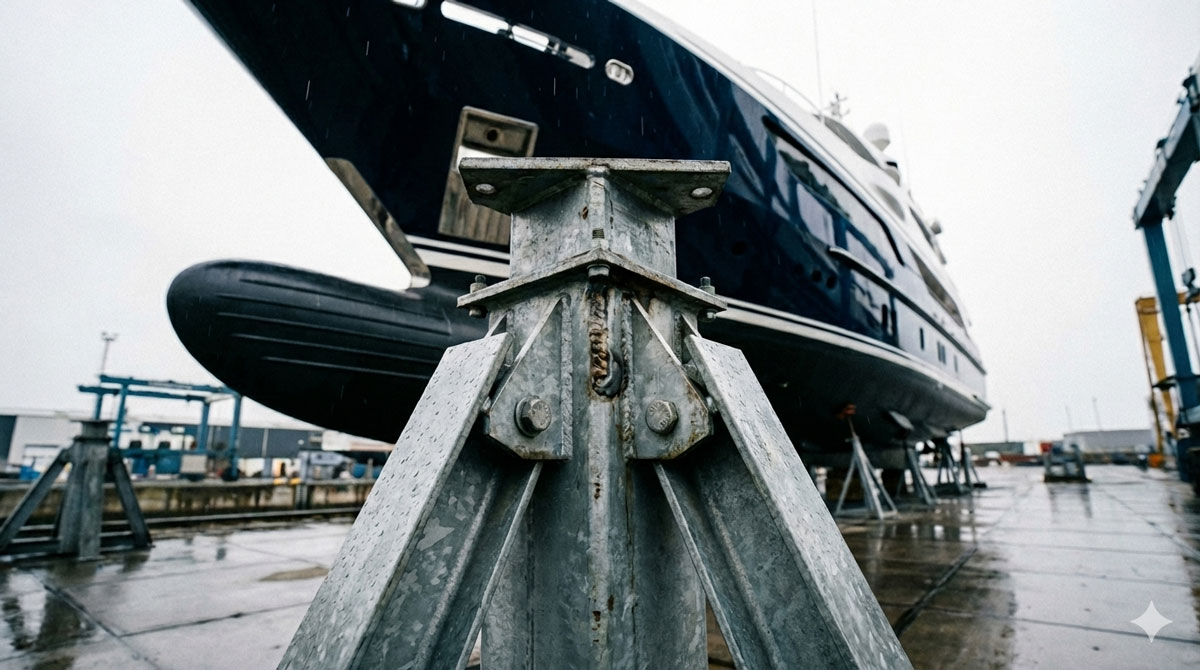
Their product? Steel bars, galvanized carts, saddles, cradles, and props. Shipyard equipment. Extremely useful stuff, but it falls squarely into the category of “least-sexy-things-to-sell.”
And yet, reading it, I realized that companies like this are sitting on an enormous narrative potential that they often waste by only talking about “load capacity” and “certified bolts.”
If you sell a technical and invisible product, your challenge isn’t explaining how it’s made, but what happens if it’s not there.
Here is how to transform “iron” marketing into a strategy that hits both the shipyard manager’s gut and their wallet.
1. Don’t sell steel, sell “peace of mind”
The classic mistake of “Saddles & Props” is sending a photo of a prop silhouetted against a white background with the text: “50-ton capacity, CE certified.” The customer’s brain records: “Okay, another piece of iron. How much does it cost? I’ll ask for a discount.”
Let’s change perspective. As we’ve seen, courting customers with “blood tests” (technical data) doesn’t work, even in B2B. The buyer of those props has a recurring nightmare: the domino effect. An unexpected 50-knot gust of wind, a structural failure, and a 10-million-dollar boat tilts and leans onto the one next to it.
Marketing this product shouldn’t be about selling the prop. It should be about selling insurance against disaster.
The emotional message isn’t “we are sturdy.” It is: “While you sleep and a storm rages outside, our steel is working to protect your revenue. You rest; we’ll handle the weight.”
It’s not just my opinion; Google says it: in B2B, emotion counts even more than in B2C, because the personal stakes (reputation, job security) are incredibly high.
2. Don’t sell the object, sell “time gained”
What a shipyard manager often accepts with resignation is how much time their workers waste “leveling” a vessel using obsolete methods.
If the marketing for “Saddles & Props” says: “We have a telescopic adjustment screw,” it’s only communicating a technical feature. And everyone has technical features, right?
If, instead, it declares: “Transform a job for three men and one hour into a job for one man and twenty minutes.” Here, the lever isn’t imagination; it’s not about trying to guess what that feature means for me. No, the lever here is profit.
If shoring up a complex hull with old wooden wedges requires a crew hammering and repositioning for half a day, you are burning operating margin. If you can do it in a quarter of the time with a telescopic system, that system pays for itself by the second boat you haul out.
The message for the technician is brutal and direct: “Our steel costs more than wood. But how much does your hourly labor cost impact your year-end? Stop paying specialized workers to do a job that our worm screw could do.”
In this way, you shift the conversation from the price of the product (direct cost) to the savings on operating costs (competitive advantage).
3. The aesthetics of order: the yard as a showroom
There is another aspect that “Saddles & Props” often underestimates: the shipyard’s ego. A shipyard isn’t just a workshop; it’s an open-air showroom. When an owner arrives to check the progress on their yacht, the first glance is fundamental because the nautical client observes everything, and their decision-making process has changed.
A yard with boats propped up by old oil drums, makeshift wood, and rusted supports communicates: “Here, we work on a budget and in chaos.” A yard with identical, geometrically aligned, clean, and galvanized cradles communicates: “Here, there is total control, engineering, and clinical precision.”
Technical marketing must hit this note: visual order is a sales accelerator. In industrial logistics, it’s called ‘Visual Management’: if the eye sees order, the brain registers efficiency and safety. If it sees chaos, it registers danger.
You aren’t buying a support; you are buying the “wow” effect your clients will have when they walk among their boats on the hard.
The lesson for Nautical B2B
Even if you sell the world’s most boring product, you have two paths, and this is where the difference between strategy and tactics becomes vital to stay on course:
- Compete on price, ending up crushed by low-cost competitors.
- Compete on perceived value, shifting the discussion from the “piece of iron” to safety, peace of mind, and corporate image.
Next time you write a newsletter for a winch, a saddle, or a generator, ask yourself: what is the nightmare this object solves for my client? Start there, and put the boring technical data at the end. It will only serve as the rational confirmation of a choice the client has already made “with their gut.”
For a visual example of this concept, look at what Caterpillar came up with some time ago.