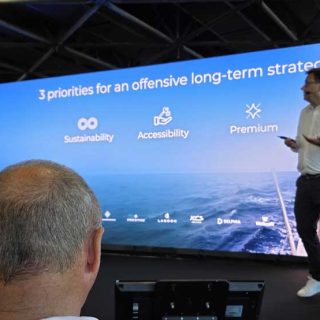
Look at the photo accompanying this article and play a game: count the under-30s.
How long did it take you? I was done quickly.
The photo comes from Winners 2026, the day the Club del Gommone di Milano celebrated the season just ended – spanning raids, charitable initiatives like Mediterraneo in Rosa, and projects for the upcoming one. The average age in the room exceeded 60.
Before running the numbers, I want to say one thing to that room: I admire you.
Since 2017, the Club has covered over 24,000 nautical miles in relay raids, according to Suzuki Italia’s tally. This year, Mission Naxos took about thirty members over 55 days and more than 3,000 miles on a 6.80-meter RIB, while for 2027 the target is North Cape.
A community capable of organizing legs between 360 and 500 miles entrusted to ever-changing crews commands respect.
As a communications agency, I admit that a group like this cannot be built with an editorial plan alone.
The Club’s raids are relay events: each crew passes the baton to the next. It works as long as someone is waiting on the line.
The numbers without beating around the bush
The National Nautical Observatory of Confindustria Nautica, presented at the Genoa Boat Show 2025 and effectively summarized here in an article by Superyacht 24, mapped the profile of the Italian boat owner for the first time.
80% are over 50, and 45% fall between 60 and 75. Thirty-somethings account for 4%, and under 30 no geographical area exceeds 5%. Below 10 meters, the average owner is 58 years old.
Regarding volumes, the Lega Navale Italiana pointed out in La Spezia at the Risorsa Mare forum that between 2015 and 2024 registered pleasure craft fell by 22% and unregistered watercraft by 35.7%. You can find a good overview in the article on Soldionline.
General Director Marco Predieri calls small boating the gateway to the sea for families and young people. The same speech cites the 2026 Blue Book on Sea Resources: a 14-meter boat requires approximately 9,500 euros a year between registration and berthing in an average marina, compared to 6,000 in Croatia and 5,000 in Greece.
The easy explanation is wallet size, and it carries weight. However, the Observatory cross-references demographics with ISTAT data on managerial salaries and uncovers a curious detail: between 40 and 50 years of age, the propensity to own a boat remains low even with high incomes, whereas it climbs past age 50.
Income explains only part of the story. At the top of the pyramid, things are shifting: Sanlorenzo reported in 2023 that the average age of its superyacht clients dropped from 57 to 48 in two years.
Lower down, however, where the boats filling marinas actually navigate, the data tells a different story.
How others are doing it
Today’s youth stream music and use bike sharing. The core issue is access, and boat builders would do well to keep that in mind. Here is a quick review of those tackling it.
Skipperi, Finland. Founded in 2017 by Anna-Leena and Kristian Raij, it sells a subscription: a monthly fee for the season, booking via app, fuel covered by the member. Maintenance, insurance, and fleet availability are managed by Skipperi. In 2023, it counted over 400 boats across six countries and closed a 7 million euro round with Yamaha among the investors. In one of its surveys, more than 53% of members stated they joined because buying a boat is too expensive. In Helsinki, the city boat format began in 2018 with a rowing boat at 49 euros a month and a motorboat at 129. By 2019, boat builder Yamarin was providing brand-new boats for Skipperi to operate: the shipyard found a distribution channel, and the channel found customers.
Freedom Boat Club, United States. Acquired by Brunswick in 2019, when it counted about 20,000 members entirely in the US, today it exceeds 70,000 members across more than 400 locations. Members average around 45 years of age, compared to new boat buyers who sit in their late 40s to 50s. Women make up 35% of members. CEO Dave Foulkes stated in 2025 that the industry’s greatest challenge is relevance. In an interview published on Pressmare that I conducted with Brenna Preisser, Group Boat President of Brunswick, she explained to Press Mare that 90% of members join with no intention of buying a boat. Foulkes added that during the due diligence for the acquisition, only about 5% considered buying a new boat. In Europe, Jeanneau announced clubs with Freedom, Beneteau runs Wizi, and Axopar partnered with Agapi, reports Barche a Motore.
SailTime and Boatsetter. SailTime, founded in the United States, operates over 30 franchises across America, Australia, and Europe, including the Netherlands in Stavoren. Its CEO Todd Hess, quoted by Yachting World, reasons like this: millennials rent the experience today, and many will buy tomorrow. Boatsetter, a peer-to-peer boat rental platform, states that 61% of its boat owners are under 45.
These figures come directly from the companies and should be evaluated accordingly, yet given that industry media widely reports them, professionals in the field ought to know them well.
They point toward a clear direction: boating as a service, with shipyards and key suppliers (such as engine manufacturers) inside the mechanism rather than watching from the dock.
The role of federations
The FIV starts from an enviable position: in 2024 it counted 157,511 members, with 46% aged between 5 and 17. Backing this is a network of sailing schools (over 600 in 2018, according to FIV itself) that gets tens of thousands of young people on the water every year.
The delicate step comes later, when they stop racing at 18 or 25. Is there a gateway leading them from dinghies to cruising, whether through ownership or boat sharing?
The FIM has fewer powerboating schools, but it is active. With races for ages 6 to 14 on RIBs powered by 6-8 and 10-15 horsepower engines. The 2024 regulations assign affiliated clubs the institutional duty of training students for competition, and the results show: president Giorgio Viscione noted that in 2025 over half the medalists were under 20.
A sporting federation naturally pursues champions. Alongside champions lies a broader demographic: young people who won’t win a world championship but could become recreational boaters, club members, and boat owners. They need a path that doesn’t depend on a stopwatch.
On Lake Como, something is moving. Yacht Club Como, together with FIM and Cantiere Tullio Abbate, launched the Lake Como Youth Powerboating Academy for kids aged 11 to 14: a training program in conscious and safe boating that also opens the door to racing for the most talented.
Tullio Abbate Jr and his wife Greta describe it as a unique initiative in Italy, designed to rejuvenate the grassroots boating community. The shipyard, as I previously reported on Pressmare, even builds boats for young kids, the Tullio Abbate Kid line.
A manufacturer investing in young people alongside a federation: the blueprint exists.
A relay with more runners
What can each player do? Shipyards should follow the example of Abbate, Yamarin, and Brunswick: put boats in the hands of young people before they become paying customers, because tomorrow’s customer is shaped today.
The NMMA (National Marine Manufacturers Association) has long documented the role of childhood exposure in building boating habits: in their 2012 study, eight out of ten active boaters reported boating as children, while seven out of ten lapsed boaters recalled childhood boating experiences.
In 2016, the Recreational Boating Participation Study estimated that the median age of a first boating outing was 12 years and that those exposed to boating during childhood showed a greater propensity to remain active boaters in adulthood: 52% versus 40% among those who stopped.
These findings confirm that early introduction to boating is a primary driver in training and retaining future boaters.
Federations should complement the racing track with a recreational track, featuring boat licensing, group outings, and boat-sharing models.
To clubs like Club del Gommone, I ask one thing, and I ask it with a smile: assign one leg of the next relay to an under-30 crew member recruited outside of members’ sons and daughters (who are thankfully present), drawn instead from friends of their children or children of friends. One leg is enough to start.
The moral is captured in that Winners photo. A 60-year-old out on the water is the best advertisement recreational boating could ask for, while a young person stepping onto a RIB today will be the one saying thirty years from now: this is how I started.
The rest is straightforward math: without new boat owners, in ten years boats will be stunning, and buyers will be scarce.
So, who are we passing the baton to?