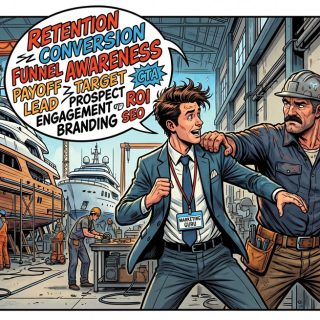
There is a scene on repeat in almost every nautical company. The entrepreneur (often an excellent technician turned businessperson) picks up the PDF of their new product, looks at it with heart-eyes, and says: “Look at these torque curves, look at these tolerances. If we send them this, they’ll buy immediately.”
Every time this happens, a salesperson dies inside. Okay, the salesperson doesn’t actually die, but a good chunk of the probability of closing the deal certainly does.
Antonio Damasio, a neuroscientist who definitely knows more than we do, flipped the script with a simple concept: we are not thinking machines that feel, we are feeling machines that think. And sometimes, I might add, they don’t think very much at all.
The “Biped” Test
Let’s take a down-to-earth (or rather, flesh-and-blood) example, entirely unrelated to gender. Imagine you are on the street. A “beautiful biped” walks past and catches your attention.
You find them attractive. You turn your head. Maybe you think: “Mmh, I’d happily spend an interesting evening with them.” Why does this happen? Because they triggered an emotion in you. It’s a question of chemistry, aesthetics, how they walk, a smile. It is an immediate instinct, fast as a snapping of fingers.
In that moment, did you ask for their name? Did you check their date of birth on their ID card? Did you ask for their blood tests to check their cholesterol levels? Did you find out if they can cook or if they prefer wine over beer?
No, because that data (the person’s “technical spec sheet”) comes later. It serves your rational side to justify the initial emotion or, eventually, to plan a long-term relationship. But the impulse, the “yes, I want them,” was born long before knowing if that person is vegan or a carnivore: you want to f*ck, you don’t give a damn if they have a university degree or use infinitive verbs correctly.
«But we do B2B, everything is serious here!» Here is where the illusion shatters. There is granite conviction that in B2B, especially in technical yachting, the buyer is an unemotional robot that processes numbers. It’s not true: and I’m not saying this to sell you consultancy, the numbers say it.
Why Emotion Beats Reason (Data in Hand)
If you think selling a stabilizer or port supply equipment is just a matter of price and specs, read this:
- 95% of decisions are unconscious. According to Harvard Business School (Prof. Gerald Zaltman), the brain decides “from the gut.” Logic arrives only later to find a plausible excuse to tell the boss. The client chooses your product because it gives them security, not because it weighs 20 grams less than the competitor’s.
- B2B is MORE emotional than B2C (yes, you read that right). Google and Gartner discovered that while in B2C emotional connection stops at 40%, in B2B it exceeds 50%. Think about it: if you buy the wrong toothpaste, you lose 3 euros. If you buy the wrong stabilizers for a fleet, you risk your job, your reputation, and millions in damages. The fear of making a mistake generates incredibly high emotion.
- Selling “Heroes,” not “Efficiency.” B2B buyers are 50% more likely to buy if they see “personal value” (Google/Motista). Don’t sell the captain “maneuvering efficiency”: sell him the certainty of not spilling champagne on the yacht owner during a turn. Sell him the feeling of being an infallible hero.
- The “Nobody gets fired for buying IBM” rule. Trust is the supreme currency. The data, provided by Gartner: 80% of buyers admit that trust (an emotion!) guides their choice. Changing suppliers is an act of courage that makes hands tremble: your job isn’t to give them data, it’s to take away their anxiety.
A Concrete Example?
We published a photo of a guy holding a Tuccoli boat suspended in the air, apparently effortlessly (the crane straps used for hauling had actually been edited out). The photo was emphasized by the text: Light Price! and accompanied by a narrative of how pleasant it was to go to sea without the weight of huge monthly installments.
The result? 800 people left their data to request more information.
Then sure, the game passed to the sales department, which at a certain point got around to talking about tank liters and range, dashboard display sizes, and delivery times. But it wasn’t the boat’s technical specifications nor the brand of fittings that made them take that first step.
Conclusion
Stop hiding behind technical spec sheets. They are useful, of course, but they are the “blood tests”: necessary to sign the contract, useless for making the client fall in love.
At LLiquida, we do exactly this: we take your technical excellence and translate it into a story that hits your client’s “gut,” whether they are a shipyard, a leisure boater, or a tourist marina.
Because before making them reason, we have to make them feel. And you, are you still selling blood tests, or have you started truly courting your clients?
If you want to talk about it, just send an email to info@lliquida.com