I’ve spent the last few weeks immersed in an extreme reading experiment: I analyzed the promotional texts of over 50 companies in the sector.
All real, all destined for publication.
As I scrolled through this florilegium, I wondered: is it possible that no one realizes?
Is it possible that those who write these presentations don’t realize they are an echo of someone else?
Don’t get me wrong: these companies sell.
Some survive, others prosper, more or less all of them deliver boats.
But they do so by leaving the customer’s choice to chance. To direct knowledge, geographical proximity, or perhaps a last-minute discount.
They don’t sell because their brand has planted a flag in the owner’s brain, but because they “happened to be passing by”.
Someone defined it as the merit of “heralism”: they chose him because he was there.
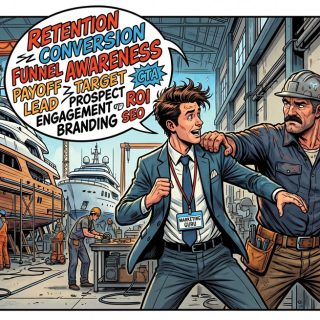
The Top 10 of Invisibility (out of 54 communications analyzed) If you take these texts and blend them together, you get an indistinguishable semantic mush.
Here are the expressions I found everywhere, with the actual numbers of their (ab)use:
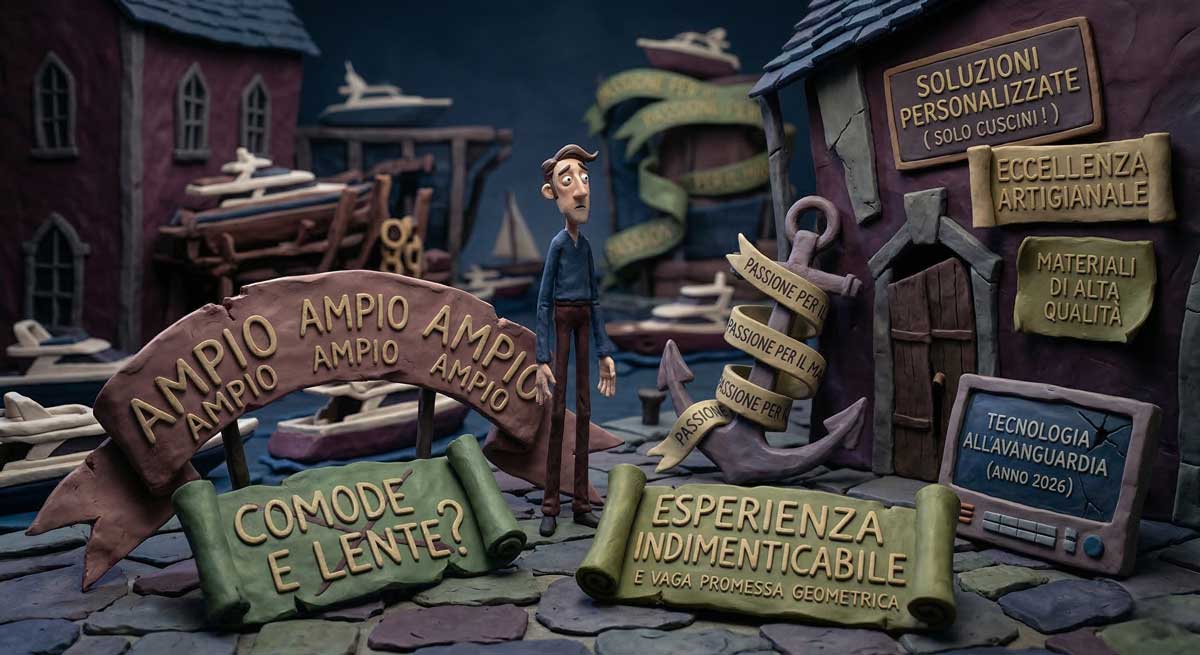
- “Ample” (cited 47 times): it is the adjective par excellence. On a boat, everything is ample: the sundeck, the glazing, the display, the living space, the cockpit, the side deck, the relaxation area, the salon… and I won’t amplify the concept further.
- “Passion for the sea/yachting” (cited by 18 companies): The standard opening phrase. It’s the bare minimum to work with one of the most luxury (and expensive) objects in existence, not a marketing strategy.
- “Comfort and performance” (15 companies): The magic duo that aims to mean everything and says nothing. How many boats do you know sold as “uncomfortable and slow” (aside from sailing boats for sailors who are more royalist than the king)?
- “Attention to detail / Meticulous layout of spaces” (14 companies): A style clause that has now become background noise. At some point, I expected someone to mention their grandmother finishing the upholstery with crochet. Or even the interior layout, crafted with a chisel. By the grandfather.
- “High-quality materials / Fine finishes” (11 companies): bah, thrown in as a self-declaration. Without ever specifying whether we are talking about steel that resists ten years of salt or wood that doesn’t burn at noon. They remind me of a friend of mine who, until he was forced to have an ID card to get his driver’s license, walked around with a page from a notebook (ruled) in his wallet that read, verbatim: “I declare that this boy is [Name] and [Surname]. Dad [Dad’s signature]”.
- “Innovative design / Clean and elegant lines” (10 companies): The universal aesthetic description, valid for a 5-meter gozzo as much as for a superyacht. And we know well how well-dressed and hygienic these lines are…
- “Unforgettable experience / Living the sea at 360°” (9 companies): A vague, geometric promise that evokes no real emotion. I’d like someone to explain how to live the sea at 180° or 270°. I won’t ask about 90° because I already know the answers would be barracks-style crude jokes.
- “Craftsmanship excellence / Made in Italy” (8 companies): Used even by those who assemble industrial components without ever having seen a planer. If I’m dealing with stylistic finishes or extreme personalization, I’m fine with favoring craftsmanship, but if I’m buying a mass-produced item, I hope it’s as similar as possible to other units to ensure the spare part fits, the electrical system is standard, and there’s room between the galley seacock and the watermaker for a larger fridge. And then, official data from La Nautica in Cifre tell us that true Made in Italy is a multi-billion euro asset that deserves to be told with much more technical precision.
- “Custom solutions / Bespoke” (7 companies): Often referring only to the choice of cushion colors. I swear it’s true, and I’ll say no more.
- “Cutting-edge technology” (6 companies): An umbrella term that hides a lack of real innovation to communicate. In 2026, cutting-edge technology means quantum computers, advanced AI conducting medical research or creating short films in hours, and androids moving like gymnasts. Touchscreen displays or infusion construction are NOT cutting-edge technologies.
If your communication is based on these ten cornerstones, you aren’t communicating: you are camouflaging.
The courage of those who stand out
Fortunately, in the middle of this ocean of “already read”, there are 5 or 6 companies that have decided to stop playing hide and seek.
They aren’t necessarily the largest, but they are the clearest.
Some have had the guts to define themselves as a “yachting boutique”.
They don’t promise everything to everyone, but they say: “We are selective, strategic, personal”. They sell a relationship before a hull.
It’s a positioning that declares: “We are not for everyone”. I’ve read about those who stopped chasing the myth of speed to position themselves as a “villa on the water”.
They state clearly that they don’t care about making you fly over the knots, but about removing the barrier between you and the blue with windows so wide (yes, it happens in the best of families) that you feel like you’re sleeping directly on the water’s surface.
This is a choice: here the customer doesn’t choose “a boat,” they choose “that way of inhabiting the sea”.
Others save themselves by anchoring to true history.
They cite the founding fathers and the philosophy of total after-sales assistance (because beautiful boats must be cared for, not just sold) or the pride of a specific geographical tradition.
They talk about wood and hands that have worked in a specific gulf for generations, creating a narrative that smells of the territory.
Finally, there are those who focus on engineering that solves problems.
They don’t sell “accessories,” they sell “design solutions” created to make every maneuver safe. Here the keyword is utility, not decoration.
Brand choice vs. choice by chance
When a customer reads 45 identical texts, their choice falls on whoever costs less or has the dealer closest to home.
It is a random sale.
When a customer reads a text that speaks to their problems, their specific desires, or expresses a worldview they recognize themselves in, then they make a brand choice.
At LLiquida, we often wonder: is it possible that shipyard owners don’t feel this gnashing of teeth every time they read their brochure?
Solid competence is born not only from knowing how to solve technical problems on the dock, but also from the ability to tell why that solution is different from all others.
You don’t need a “tailor-made suit” (how many times have I read “stitched to fit”), you need an identity that is recognizable, even without reading the brand name.