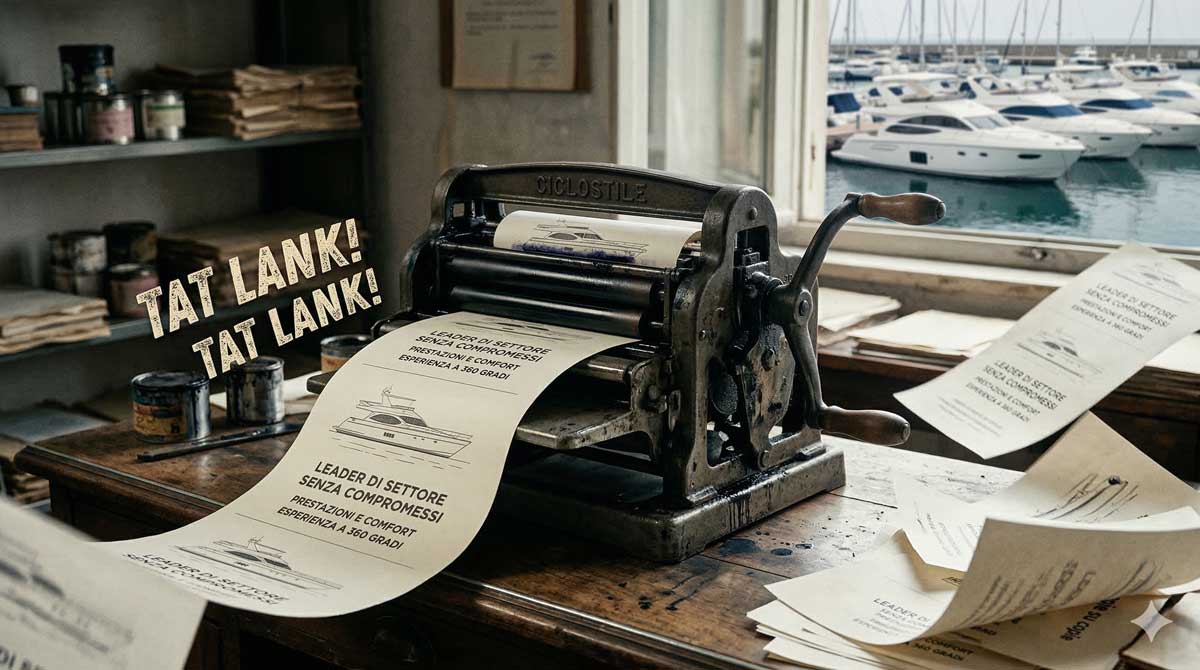
As a child, there was one thing that fascinated me immensely at school: the mimeograph.
Before photocopiers became common, that was the system for replicating text.
You would turn the handle and it would churn out copy after copy.
One turn, “tatlank!”, one copy, another turn, “tatlank!”, another copy.
And so it went, until the paper or the ink ran out.
Beautiful for a child whose only other experience of such magic was carbon paper.
Magical too, but far less powerful.
As I grew up, I realized that this fascination with the copy has remained today.
Certainly in the world of boating.
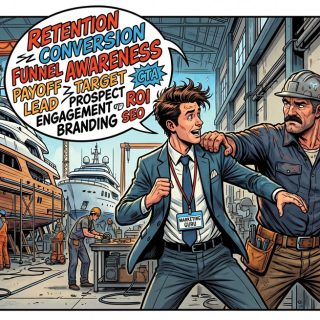
If you read ten brochures from ten different shipyards, you will discover that all boats are: leader di settore senza compromessi progettate per offrire prestazioni e comfort.
And they all promise the same thing: a 360-degree experience.
The result? Reading the brochures, it seems that all boats are incredibly similar.
Boats are not all the same.
Differences really do exist, it is just that they are rarely told.
A boat can be designed to: go out for a few hours on a Sunday or face a week-long cruise.
And this changes its nature significantly: in the first case, you do not need all the weight required in the second in terms of systems, accessories and furnishings.
In the first case, a top-loading fridge for two drinks and some beach cushions are enough; in the second, you need 400 liters of fresh water and lockers capable of holding a week’s worth of groceries without the jars becoming projectiles at the first wave.
In practice, these are differences that completely modify the philosophy of the project.
Yet the language we use to describe them remains the same.
I have happened, between boat shows and harbor visits, to hear people claim that the difference between a trawler and an open was exclusively the presence of the deckhouse – or rather the “cabin”.
No reference to the type of navigation: one displacing, one planing, or to the use: one designed for long-range cruising and the other as a fast commuter.
And unfortunately, there is less and less ability to “educate” because the habits and customs of boaters have changed.
In the last twenty years, yachting has undergone a much deeper change than it seems. It does not just concern hulls or layouts.
It concerns the reason why people buy a boat.
Once, the owner was often an enthusiast: they knew their boat; they knew how to judge its nautical qualities; they knew its limits.
Today, however, many owners are consumers of experiences rather than being interested in the boat itself.
The choice often follows this hierarchy: how the boat looks – meaning what kind of impression I will make being seen on it; how I imagine life on board – meaning how comfortable I will be on it; how it sails – which is more of a: what is the cruising speed.
Nautical qualities only really come into play for those who sail a lot, fish seriously, or truly travel by wind.
Today there is something for everyone: for the expert and for the novice, for those who want to appear and for those who want to be.
The problem is not the variety of boats, it is that we describe them all with the same words.
If we look at the design of boats in recent years, the change becomes evident.
Larger and larger volumes.
Enormous windows everywhere.
Separate showers even on eleven-meter boats.
Ever-increasing interior heights. Interior heights that allow a man of one meter and ninety to take a shower without having to tilt his head, a luxury unthinkable until a few years ago.
The mental model has shifted from “boat” to floating house.
For goodness sake, in terms of comfort, it is all an advantage.
Yet it is precisely these qualities, less and less considered, that make the difference when the sea is not the one in the brochures.
There are characteristics that those who truly sail recognize immediately. The efficiency of navigation.
The capacity to maintain cruising speed with a rough sea.
The durability of the construction.
These are qualities that are not seen at the dock and are not measured in a ten-minute trial. They are understood with time.
Often after years.
The problem in yachting, more than designing different boats, is finding different words to describe them.
As long as we continue to describe every boat with the same vocabulary, they will all continue to look the same to us.
Furthermore, yachting – and boaters – would benefit from returning to storytelling: how one truly sails; why a boat was designed in a certain way; who it was designed for.
Because a boat, before being an object, is a way of experiencing the sea.
And the sea has never been a standardized thing.
Because “O mare fa o mare” (the sea does the sea).
As Eduardo De Filippo said in his namesake, beautiful poem.