The morbid fascination of the extra sector
For a few days now, when you go up the stairs, when you get in or out of the car, your knee hurts. Since the ointments and painkillers you have at home don’t relieve the pain, and in fact the days go by and it increases, at some point you decide to go to a doctor to solve the problem.
Question: do you go to an orthopedist or an ophthalmologist?
In my opinion, even if sometimes the pain that starts from the joint makes you see stars, you still opt for the first specialist. Even if the second is a doctor as renowned as the first.
Just as to cut your hair you go to the barber and not the tailor, even if both use scissors. Or to buy your boat oilskins you go to the ship chandler and not the tailor mentioned above, even if both deal with clothing.
True or not?
Depending on your need, you go to the specialist you consider most expert in that field or who uses the same tool in a way that is more suited to your needs.
Well, in the nautical world it’s not always like this.
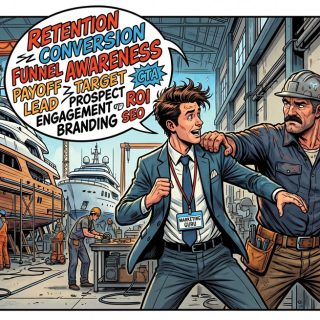
There are many examples where the shipyard or in any case the company operating in this sector decides to entrust its marketing and communication to someone who, basically, deals with something else.
To bring the discussion back to the examples above: marketing and medicine are “science”; yachting, like orthopedics, is the specialization. Or, marketing is the tool, like scissors; tailor or barber is the specialization.
The basic reasons why you choose someone who is not vertical on yachting are three.
One is ignorance.
It is thought that those who communicate well the big brands of high fashion, or, mutatis mutandis, the brilliant local business, can achieve the same excellent results even in a field as peculiar as yachting where, just to mention one, we speak a language all our own.
The second reason is proximity, which includes two sub-cases: kinship or geographical proximity. In the first case, it’s the famous cousin and therefore you choose him because he costs little, period. In the “spatial” sub-case, the reduced distance is enough to give an added value. As we have been told: “because they are close and therefore we see each other in person”. I advance a hypothesis: probably those who make this choice were struck by the law of universal gravitation which explains that the attraction is stronger the closer the masses involved are. Oh, Newton said it, not the last idiot. So if I’m close to my agency, I attract more customers.
The third is generally the reason that fascinates those who feel ready for the “quality leap”. The thought is: “Let’s go to the company that deals with the extra sector so we can enter the extra sector too. Enough of the usual yachting magazines, enough of the usual shows. From now on we will conquer the high-spending market (that’s the big siren) thanks to the shop windows in Via Montenapoleone, the covers of Vogue and the editorials in the Washington Post”.
Now, without prejudice to the legitimate desire to expand your communication range beyond the usual nautical media, I ask: why should someone who talks about shoes, furniture or cars be able to make a boat more appealing to those who have never heard of boats or have never considered them?
To clarify an easy point: if a shipyard wants to have news in a non-nautical newspaper, it’s not that those who deal with nautical press offices don’t have the contacts to get to the Corriere della Sera, the airline magazine, the hotel chain or the credit card. I’ll also reveal the open secret: often more than the news, to convince the director of one of the aforementioned magazines is the advertising investment, but this is a discussion that should eventually be explored elsewhere. However, be careful what you want because the numbers, read: money, we are talking about are very different from those that shipyards generally think about when they talk about marketing (referring among other things to advertising).
I’ll just mention another consideration: it’s rare that the appearance of a boat in an extra-sector context generates a purchase. It is more likely that someone saw the boat in a port or asked a friend who already has one. Or that he did something crazy like looking in a yachting magazine or in one of the various forms of online communication. But for sure if you are “here and there” your chances of finding customers increase.
Having said all this, do you know why in the end those who make the leap of faith and choose the non-nautical ultimately go back and turn to those who are in this field?
I’ll give you at least 5 reasons
1. Specific knowledge of the sector
A yachting-specialized agency already knows the language, the target audience, its protagonists and market dynamics. It knows which communication channels are most effective for reaching specific customer segments. This means less time spent explaining the product and target audience and more time spent on effective strategies. Furthermore, it knows the trends, reference events (fairs, regattas, boat shows), and the most functional marketing levers for the right audience.
2. Qualified network and contacts
A yachting-vertical agency already has relationships with specialized media, industry influencers, yacht brokers and other key stakeholders. This facilitates PR, direct and digital public relations and co-marketing opportunities usually precluded to a generalist agency.
3. Targeted content and storytelling
Communication in the nautical sector has its own language and a distinctive aesthetic. A specialized agency knows how to tell the brand authentically, without making mistakes that turn your communication into a disqualifying joke for enthusiasts and insiders. Those who already promote boats fully understand the technical characteristics and unique advantages of the shipyard’s products and services. It knows how to best enhance them, effectively communicating the advantages to the target audience, which in turn has specific needs and expectations. If the text of a Facebook post is written by someone who only sees the sea from the beach, you can tell from the second line. And even more so today that often the agency kid who deals with social media management has the texts written by Chat Gpt. Empty phrases because there is no knowledge to fill them with content. I saw an embarrassing press release that read: “Born from the encounter between innovation and tradition, [omitted] redefines the canons of elegance and performance. A masterpiece of engineering and design, designed for those who are not satisfied, but aspire to unprecedented experiences. Every detail has been expertly studied to offer a perfect balance between comfort and functionality, guaranteeing an unparalleled navigation experience. The sculpted lines express a bold and contemporary soul, while the selected materials embody luxury in its purest essence… [continued, unfortunately]”. And not only do I find it embarrassing, but so does anyone who wants to buy a boat. And it doesn’t matter if you read it on Facebook, Superyacht Time, or the Wall Street Journal.
4. Investment optimization
An agency with experience in the sector will know where to allocate the budget to obtain the maximum return on investment, the famous ROI. It already knows the best channels for advertising campaigns (or ADV as the “learned” ones call it), it knows which partnerships to activate and which fairs/competitions to sponsor. And it is able to develop targeted marketing strategies, optimizing investments and maximizing returns in terms of visibility, leads and conversions.
5. Credibility and Positioning
It is the result obtained by adding the previous points.