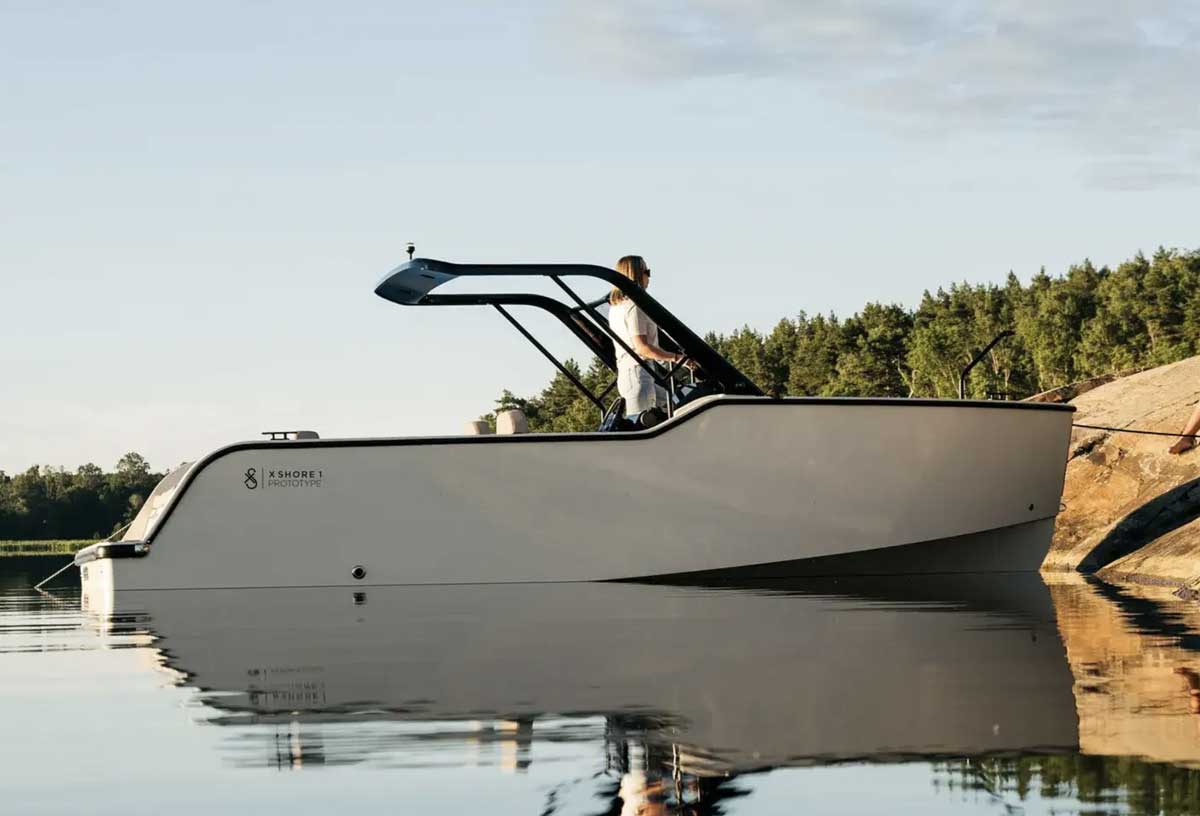
The first time I saw an X Shore, I think it was at the Cannes yachting festival, I thought: “wow, these guys have really done something new, beyond electric”. Of course, for some they were very ugly boats, but I find them endowed with a certain charm. Current Nordic design.
So new that we didn’t understand it. Or rather: the market wasn’t ready.
X Shore has gone bankrupt despite an excellent product, over €100M raised, and international awards. Here is why:
1. Premium market too small and immature for electric
X Shore targeted high-performance luxury boats (superyacht tenders, chase boats, 25-30 foot models starting at ~€250-400k), a niche segment. The nautical electric market is still tiny compared to EV cars: the technology (batteries, range, charging at sea) is not as mature as in land vehicles, and “big money” clients (superyacht owners) often still prefer diesel for reliability, range, and easy refueling.
Furthermore, port infrastructure is lacking: high-power charging stations at sea are very rare, unlike the charging network for EV cars. Without this infrastructure, even those who wanted electric backed out.
There was not the necessary sales volume to amortize costs.
2. Very high fixed costs and unsustainable burn rate
A business model that requires significant capital (high initial investments): product creation, custom or small-scale production, and complicated management of component supply (such as batteries, electric motors, and special materials).
They accumulated enormous losses: in the last 3 years, approximately €23 million in the red (mostly in the production division), with unpaid rent of ~17 million Swedish krona (~€1.9M) for the factory alone.
Even after various rounds (over €100M total raised from high-profile investors), the funds were not enough to cover operating costs while production failed to scale.
3. Difficulty scaling production and reaching break-even
They launched award-winning products (X Shore 1, Eelex 8000), but the ramp-up was slow. Limited production → high prices → low sales → negative loop. They failed to transition from prototypes/premium to decent volumes.
Unlike Tesla, which was able to scale from premium segments (Model S/X) to mass market (Model 3/Y), in the nautical sector the total market volume is orders of magnitude smaller. That strategy simply does not work when the market itself is too small to sustain the learning curve.
4. Unfavorable post-Covid macro context
The nautical market saw a boom during the pandemic, followed by a 30-40% collapse in the subsequent years (2023-2025). Unstable supply chain, inflation on materials/batteries, and a general slowdown in luxury.
Devastating fundraising timing: they raised a lot during the green/EV euphoria period (2020-2021), but when sentiment cooled (2023-2024), finding new capital became impossible exactly when it was needed to survive the nautical market crash.
Additionally, some commentators cite an anti-EV “headwind” (e.g., less favorable battery policies in the USA), which impacted sentiment.
5. Failed acquisition/buyout
Despite visibility (awards, green hype), no serious buyer stepped forward during the bankruptcy proceedings (no valid offer by November 2025 for the production arm). This sealed their fate.
In summary: it was a visionary idea (quiet, sustainable, high-performance boats), but the timing and the chosen segment did not allow for reaching economic critical mass. It is the classic misalignment between innovation and market timing: being a first mover is not enough if the market is not mature and the financial fuel runs out first.
Many nautical EV startups are hitting the same wall (e.g., similar cases in Scandinavia in recent years). Electric at sea will arrive, but likely with:
- More consolidated larger players (Brunswick, Volvo Penta) who can absorb initial losses
- Strong state subsidies or focus on higher volume segments (e.g., small workboats or rentals) where lower operating costs of electric justify the investment
- Regulations that force the transition (e.g., diesel bans in certain lakes/protected areas)
Unfortunately, X Shore paid the price of being a pioneer in a sector that was not (and is not yet) ready to scale economically.