Children resemble their times more than their fathers.
It was said by the sociologist Guy Debord, and before him, I heard my father say it in different words when he spoke with his friends about me and my peers: “…they are children of their times”.
It always struck me that he said it as an advantage, not a reproach: times change and generations adapt.
Okay, life, the universe, and everything else, but what does this have to do with boats, marketing, and communication? It’s not just related: it’s fundamental.
We grew up in a world where people bought a boat because they were in love with the act of going to sea with that object. Whether under sail, power, or in a dinghy, owning a boat was something that was part of existence, in a sense completing it.
At the Genoa Boat Show (that was the boat show), if you liked a boat, the first thing you did was lift a floorboard and look at valves, seacocks, fiberglass workmanship, etc.
There are still examples of this way of living the nautical world. Those thousands of boaters who, on weekends, either go out to sea or take on winter chores if the boat is on the hard. Most are sailors or fishermen. And most of these are people who are at least 50 years old, at least.
And here the first changes are observed: today the first thing you do when you find a boat you like is ask how big the pop-up TV in the dinette can be, if there is air conditioning, or where to put the stabilizer.
This is not wrong in absolute terms, in itself: how many open the hood when they go to the dealer to buy a car? And how many are able to understand what they see?
But everyone asks if there is air conditioning, a smartphone connection, or other amenities that have nothing to do with “driving” (translated into nautical terms: the emotion or desire to go to sea) or “going from point A to point B” (being able to get there by water and in autonomy).
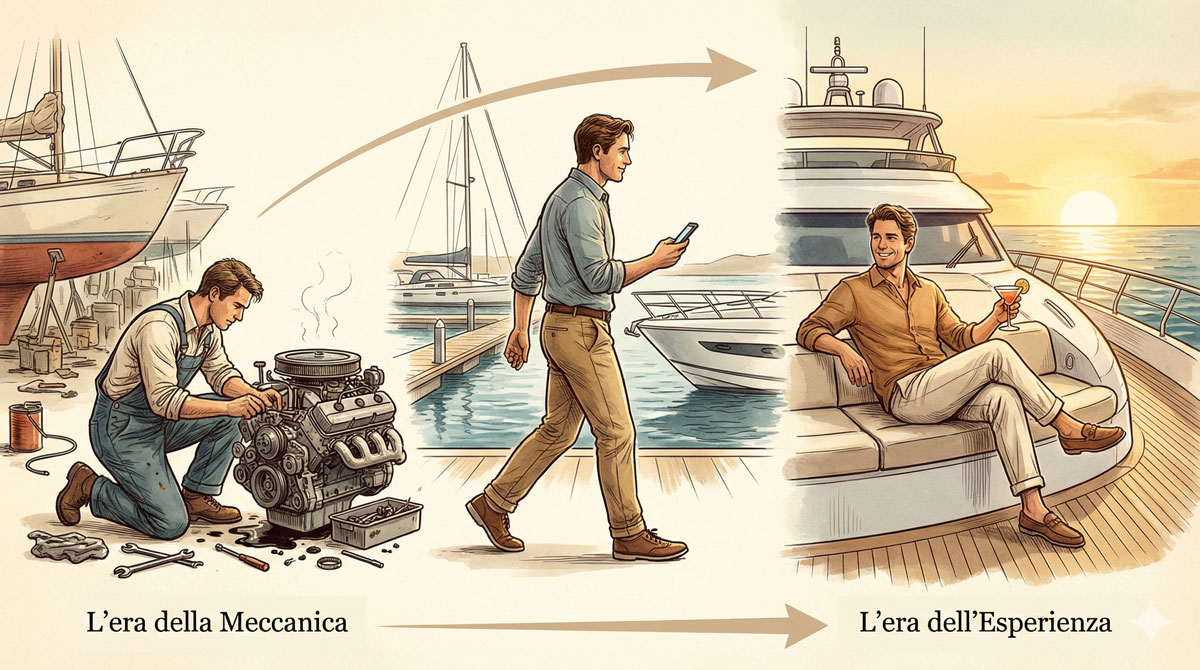
The point is that passion is not dead, it has simply changed address: it has moved from the object to the experience.
Once the enthusiast was a sort of engineer who enjoyed hearing the sound of perfectly synchronized engines; today the enthusiast is a curator of their own time who enjoys seeing how the boat transforms into the perfect stage for their lifestyle.
They don’t care how the bilge pump works, they care that the pump guarantees they won’t have to think about anything but the ice in their cocktail.
Just as you take for granted that a Kia, a Mercedes, or a Pagani will take you where you want to go, today those looking for a boat take for granted that it is a product that will allow them to do what they want to do.
In other words, quality—a word with which all shipyards fill their communication—is not something that shifts the purchase because it is taken for granted. Saying today “we produce quality boats” is like a restaurant writing on the menu “our ingredients are not spoiled”.
It is the bare minimum, not a strategy. Because everyone, besides having “passion,” has “quality”: positioning 0.
So rather than saying you have quality, you have to prove it in ways that matter to the contemporary customer.
Second issue, today global wealth has increased to all-time highs, but we are also at all-time highs for disparity of distribution. So, yes, in general there is more money.
Between 2000 and 2024 alone, global wealth nearly quadrupled, going from about 160 trillion dollars to about 600 trillion dollars. Further good news, there are also fewer poor people: the percentage of adults in the lowest wealth bracket (under $10,000) went from 75% in 2000 to 40% in 2023.
But all this money is in fewer hands: in 2000, the richest 1% held 40% of global assets. Starting from 2022-2023, the trend shows a further increase in concentration, with a large part of the wealth owned by a narrower percentage of the population.
It means there are fewer people who can buy a boat and someone who can buy steel giants with beach clubs as large as downtown apartments and garages ready to hold three tenders and an SUV (notice how well megayachts are doing?).
So: there are fewer enthusiasts, meaning there is less desire for a “boat”. There is less need for purchase, when you can charter. There is less money to be spent lightly.
So, should we stop selling boats?
No, we just need to start selling them differently.
Like you sell diapers, toothpaste, or spaghetti. Or, if you want, luxury cars, jewelry, and high fashion.
That means studying the customer and analyzing their behavior, leveraging data rather than Sunday morning gut feelings.
Applying what neuroscience tells us about how to capture the attention of someone who has 500,000 euros to spend and must decide whether to put them into a fisherman, a villa in Tuscany, or a watch collection.
Times change and those who don’t adapt disappear.
Three billion years ago, cyanobacteria dominated the planet. Then they started producing oxygen as a waste product of their metabolism. Oxygen was toxic to most life forms of the time—including the cyanobacteria themselves.
The gas began to oxidize everything that could be oxidized, including land and air. This event radically changed the planet’s chemistry, leading to global glaciations and laying the foundations for the evolution of complex life.
Many organisms went extinct. Others learned to breathe that poisonous oxygen and turned it into their competitive advantage.
Today those “others” are us. In the nautical sector, the toxic oxygen is the customer who no longer wants to be an owner-engineer.
You can complain that the air has changed, or you can learn to breathe it better than anyone else.
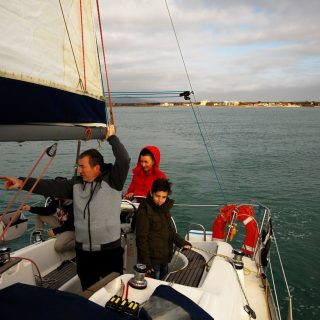
Dockmate, the remote control for boats, could have been sold as just another gadget to add to the dashboard. When we presented it as the device that relieves docking anxiety, avoids embarrassing moments, and prevents you from arguing with your wife and son during maneuvers, quote requests tripled in two months of social media campaigning.
And if you want to understand which anxiety is keeping your customers awake at night (it’s not the amount of fiberglass layers), let’s talk. Because finding your ‘docking anxiety’ is exactly the kind of work we do.
The important thing is not to think that if the air is no longer breathable, it’s enough to just hold your breath.