“No one knows my owners better than me.”
If I had a euro for every time I’ve heard this on the dock or at a boat show, I’d probably be writing to you right now from the cockpit of a Swan 65 (ketch) in the Caribbean.
And don’t get me wrong: the experience of someone who has lived in the shipyard for thirty years is sacred.
Commercial instinct—that ability to look a client in the eye and understand if they will buy—is an irreplaceable asset.
But there is a problem: online, you can’t look anyone in the eye.
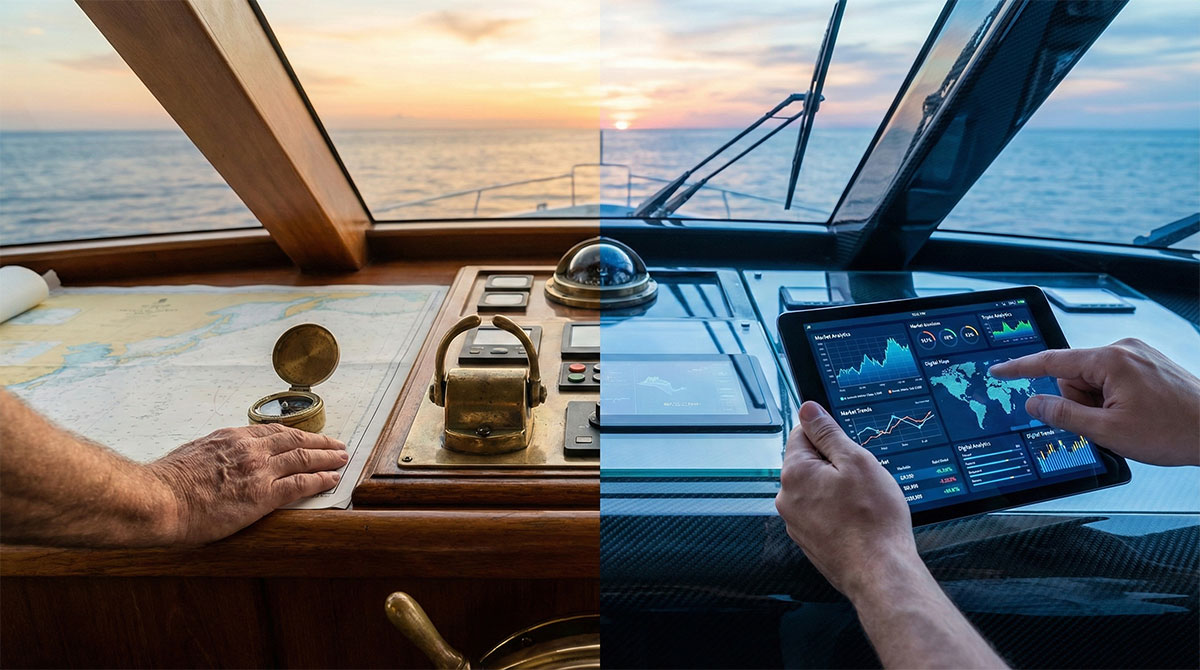
In the digital world, intuition must hand over the helm to data.
Because while you think you are competing with the shipyard next door, your client is looking at something else entirely. And while your technical office writes spec sheets full of maximum beam and shaft lines, the client is searching Google for only one thing: how to keep their wife and children from getting sick at anchor.
In these years with LLiquida, I have analyzed gigabytes of data and isolated glaring errors that I see repeated cyclically. Errors that turn multi-million budgets into… background noise.
Let’s look at them together (and understand how to fix them).
1. Fighting the Wrong Enemy: Your Competitor Is Not (Just) Another Boat
Ask a commercial director who their competitors are, and they will list three or four nautical brands that build boats of the same length.
It is a logical answer, but a partial one.
In the High Net Worth Individual segment, the yacht is just a “budget container” within a broader experiential portfolio.
The owner who is evaluating an upgrade from 24 to 30 meters (we are talking about an 8-10 million ticket) is not just deciding which boat to buy.
They are deciding whether to buy the boat or allocate that liquidity elsewhere, as confirmed by trends on the rise of the Experience Economy at the expense of luxury goods.
Before me, this was stated by the Global Wealth and Lifestyle Report, an analysis by the Swiss Private Banking group Julius Bär.
Often your real competitor is not the rival shipyard, but:
- a chalet in Cortina or St. Moritz;
- a share in a private jet club;
- an investment in branded real estate.
If your communication speaks only of fiberglass and not of lifestyle, privacy, and exclusivity (i.e., the only things a penthouse in New York cannot give you), you have already lost from the start.
Not against another boat, but against another life.
“Friendly Fire”: Shipyard vs. Dealer
Then there is an even more insidious enemy: yourself. This happens when the Shipyard and the Dealer do not coordinate and end up bidding on the same Google keywords.
It is a phenomenon highlighted by HawkSEM in the Honda Case Study (PPC Cannibalization) known as keyword cannibalization, which in the automotive sector burns up to 30% of the budget if not managed centrally.
Result:
- The cost per click (CPC) explodes uselessly.
- The user finds themselves facing two almost identical ads and gets confused.
- Tracking leads becomes a nightmare.
The solution is not to stop investing, but to divide the tasks: the Shipyard presides over the brand and inspiration (upper funnel), the Dealer presides over the territory and specific offers (“used Liguria”, “sea trial Naples”).
Just to say: one of our clients reduced CPC by 40% in 6 months just by separating keywords between shipyard and dealer.
2. Speaking “Engineering” to Those Who Just Want Peace of Mind
There is an abyss between what shipyards love to say and what owners want to know. Official websites are cathedrals of aesthetics and technique: they speak of “innovative design,” “active gyroscopic stabilization,” “ABS certifications.”
But do you know what people really search for on Google or ask the broker in a whisper? Here is the brutal translation from shipyard language to owner language:
- The Shipyard says: “Stabilization system with optimized moments of inertia.”
- The Owner searches: “Boat that doesn’t rock at anchor” (because if the wife gets sick, the boat is sold after one season) or even, how to prevent guests from getting seasick, a need that often outweighs top speed in importance.
- The Shipyard says: “Crew layout with independent access.”
- The Owner searches: “Is the sailor’s cabin comfortable?” (because they know that crew quality of life impacts the vacation more than knots of speed).
- The Shipyard says: “Propulsive efficiency at 22 knots.”
- The Owner searches: “How much diesel does it take to go from Portofino to Santa Margherita?” (they want to understand the “cost of the weekend,” not thermodynamics).
If your site answers only with cold numbers and unreadable 30MB PDFs, you are letting someone else emotionally reassure your client.
3. The “Showcase” Obsession (That Doesn’t Sell)
The aesthetic vice in yachting is lethal. I see beautiful sites, emotional 4K videos that start in autoplay… and then a functional void.
The most frequent technical error is not design, it is friction.
Imagine a potential client browsing from their smartphone (maybe they are at the airport, or at dinner). They see your ad, click, and:
- The page takes 8 seconds to load because there is a huge video.
- To get information, considering that in luxury over 67% of traffic comes from mobile, they have to download a 20MB PDF which is a nightmare to read on a phone.
- To download it, they must fill out a form with 12 mandatory fields, as if they were applying for a mortgage.
Result? They close everything. You paid for the click, you brought the user to the door, and then you slammed the door in their face.
An effective Landing Page must be a service, not an interrogation. It must give value immediately, perhaps with a simplified configurator or a clear technical sheet readable without download.
4. The Black Hole of Leads: “Info@”
Finally, the bonus error. The one that hurts the wallet the most. Suppose you did everything right: correct strategy, fast site, the lead arrives. A potential owner writes: “Evaluating upgrade within 18 months, would like info on running costs.”
What happens in many nautical companies? The lead ends up in a generic info@ inbox. It is forwarded “for information” to a local dealer overloaded with work. The dealer sees “within 18 months,” thinks “this is cold, it wastes my time,” and doesn’t reply. Or they reply after 4 days with a standard email.
Now consider this: according to The Lead Response Management Study by Harvard Business Review, such behavior means giving away a client. Statistically, 78% of sales go to the first responder and replying after 30 minutes reduces contact chances by 100 times.
That contact wasn’t cold. They were at the beginning of their journey. Ignoring them means gifting a client (and a million-dollar budget) to that competing broker who instead has a CRM set up for nurturing, who calls immediately, who sends useful content for months until the client is ready to sign.
You Don’t (Just) Need More Budget, You Need More Method
Nautical marketing isn’t magic. It is a mix of Visual (to make them dream), Technology (not to lose contacts along the way), and Data Analysis (to understand where the money really goes).
At LLiquida we do exactly this: we don’t just make “beautiful sites” or “manage social media.” We build the ecosystem that transforms interest into negotiation, preventing your budget from ending up lost in the open sea.
Se vuoi capire quali di questi errori sta frenando la tua crescita, parliamone. (If you want to understand which of these errors is holding back your growth, let’s talk.) Sometimes correcting the course by a few degrees is enough to arrive at a completely different port.
Want to know how many leads you lost in the last campaign because someone replied after 4 days? Let’s talk without beating around the bush.